Explore Real Residential & Commercial Wood Fence Installations by Exterior Fence Builders, Inc.
Family-Owned Since 1988 | Lawrenceville, Georgia | Serving Gwinnett County and Metro Atlanta
Choosing a wood fence involves more than selecting a height or deciding between privacy and decorative styles. The right fence should complement your property, provide the level of privacy, security, or separation you need, and be constructed with materials and methods appropriate for its intended use.
At Exterior Fence Builders, Inc., we’ve been building wood fences for residential, commercial, and specialty property applications since 1988. Our collection of completed projects showcases the different wood fence styles, materials, construction details, and custom designs we’ve installed over the years.
Whether you’re a homeowner planning a backyard privacy fence, a business owner improving your property, a commercial property owner evaluating perimeter fencing, a property manager coordinating repairs, or a homeowners association responsible for community improvements, our gallery provides examples of actual fencing projects and the construction details behind them.
Explore original project photographs alongside updated visual presentations to see the workmanship behind our fences and understand the features that distinguish one design from another.
Explore Wood Fence Styles and Designs
Traditional Wood Privacy Fences
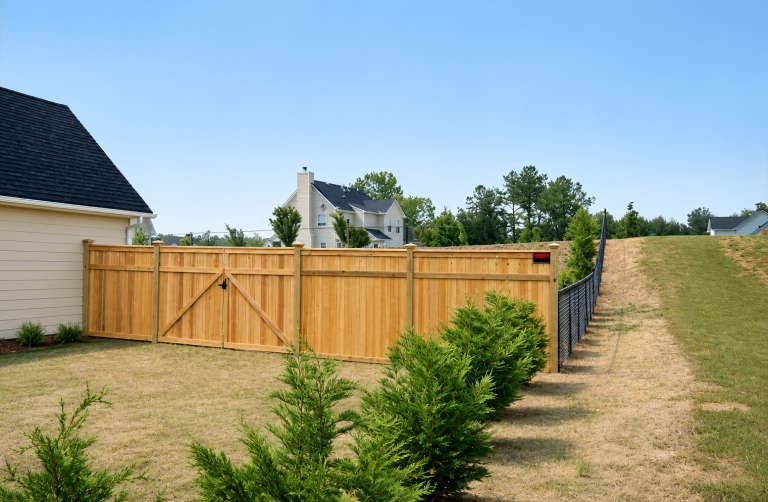
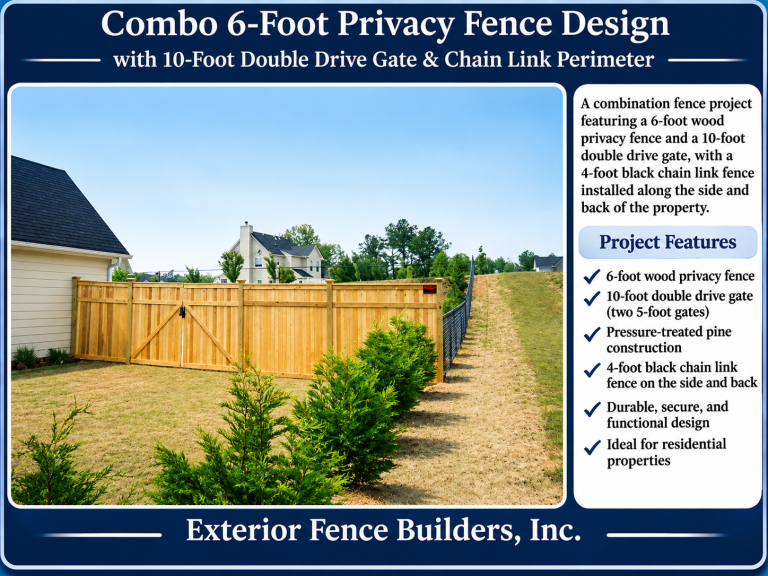
Discover 6-foot and 8-foot wood privacy fences constructed with pressure-treated pine and cedar. Explore traditional stockade designs, dog-eared pickets, and different finishing options for backyard privacy, property boundaries, commercial property screening, and outdoor living areas.
Wood Shadowbox Fences
Explore wood shadowbox fence designs featuring alternating pickets that create a distinctive appearance on both sides. These fences offer a balance of privacy, airflow, and decorative appeal for residential properties, shared property boundaries, and appropriate commercial applications.
Semi-Privacy Wood Fences
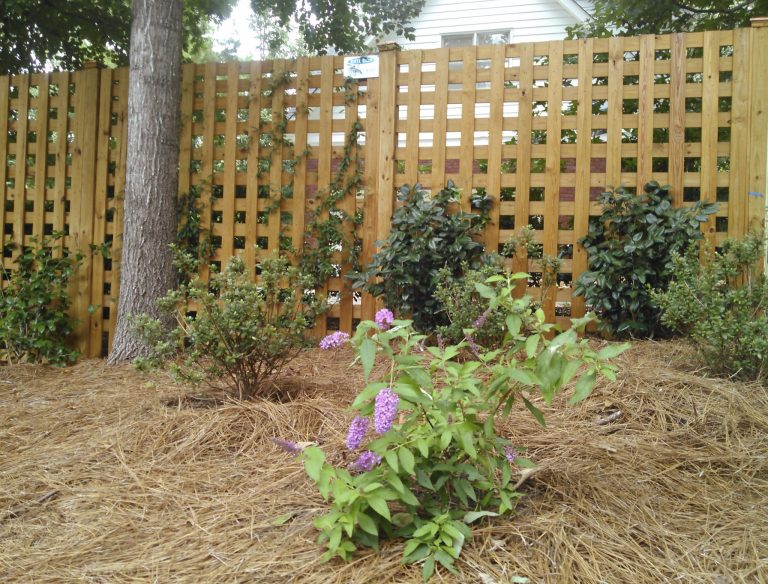
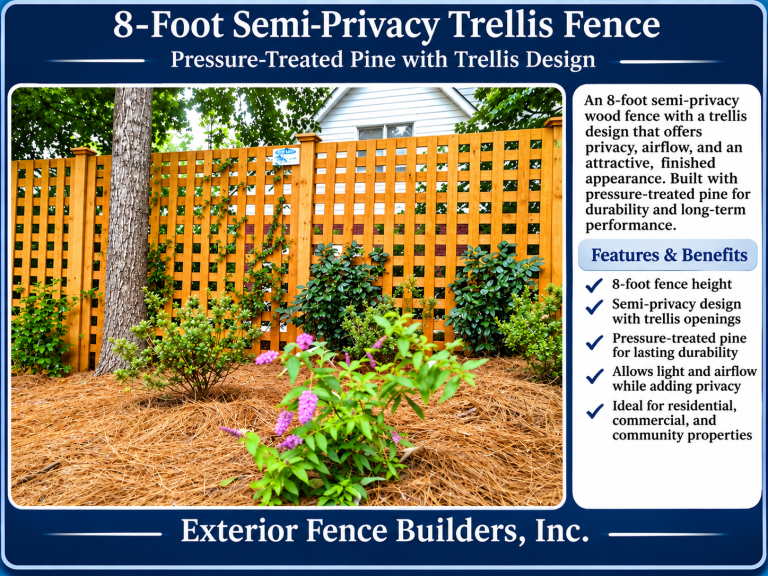
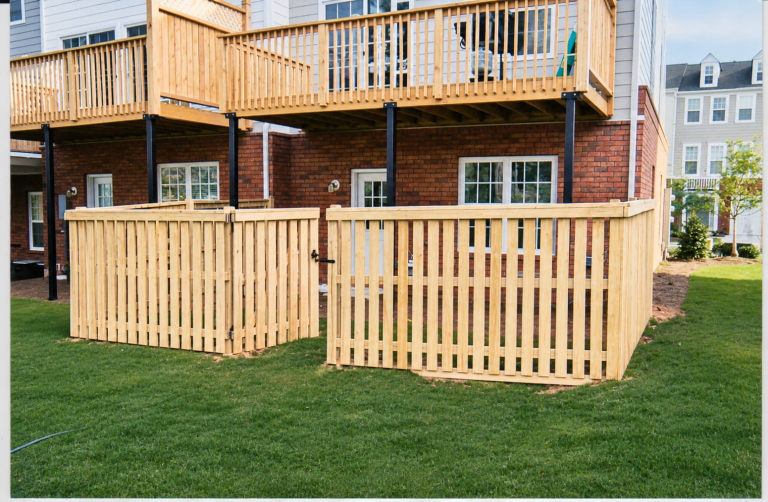
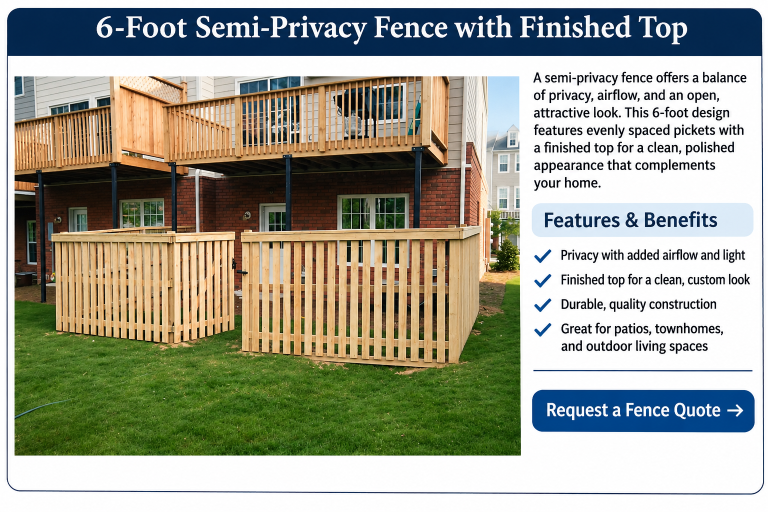
See wood fencing designed with intentional spacing between pickets. Semi-privacy fences provide separation while allowing additional light and airflow, making them useful for patios, outdoor living spaces, business properties, and other residential or commercial applications where complete visual screening is not required.
Custom Wood Privacy Fences
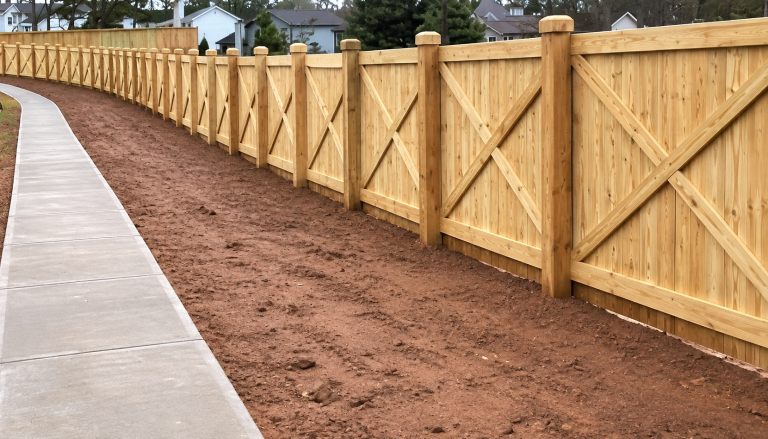
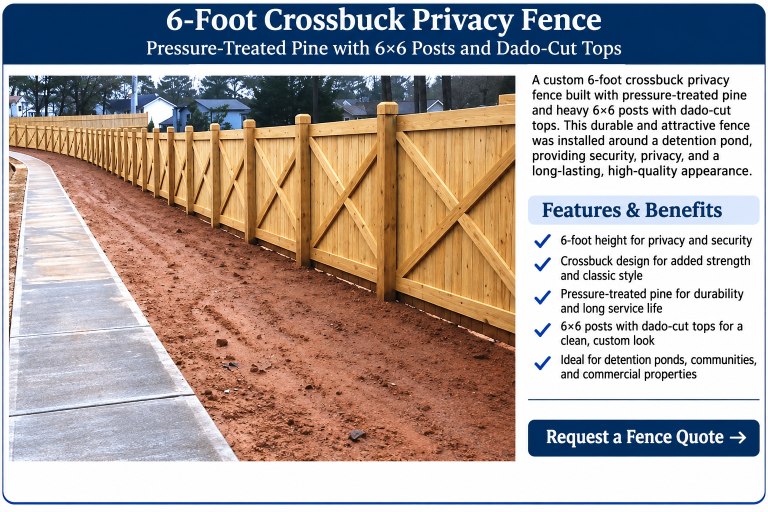
Explore custom wood fence construction featuring crossbuck designs, decorative trim, finished tops, cap-and-fascia details, and other architectural features. These projects demonstrate how wood fencing can be adapted to individual residential properties, commercial facilities, community developments, and specialized perimeter requirements.
Exposed-Post and Arched Wood Fences
Discover privacy fences featuring exposed posts, French Gothic post tops, and arched fence sections. These designs combine decorative craftsmanship with distinctive construction methods and can complement residential landscapes, subdivision entrances, community properties, and commercial settings.
Wood Picket and Decorative Fences
Explore spaced-picket fences, decorative arches, and traditional wood fencing that defines property boundaries while maintaining visibility and an open appearance. These designs can serve residential yards, landscaped business properties, community common areas, and other locations where appearance and boundary definition are important.
Farm, Ranch, Rail and Crossbuck Fences
See pressure-treated wood fencing used for larger properties, open landscapes, agricultural settings, community developments, and specialized perimeter applications, including crossbuck designs and welded-wire combinations.
Original Photographs. Real Projects. Documented Experience.
Our wood fence gallery is built around actual residential, commercial, and specialty projects completed by Exterior Fence Builders, Inc.
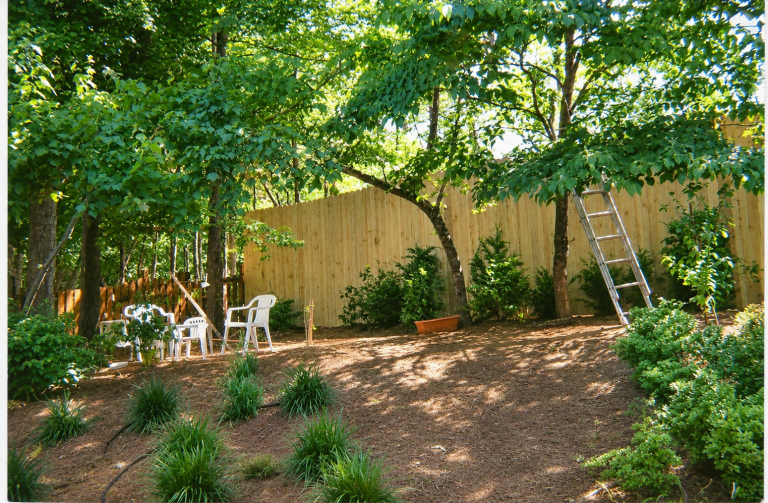
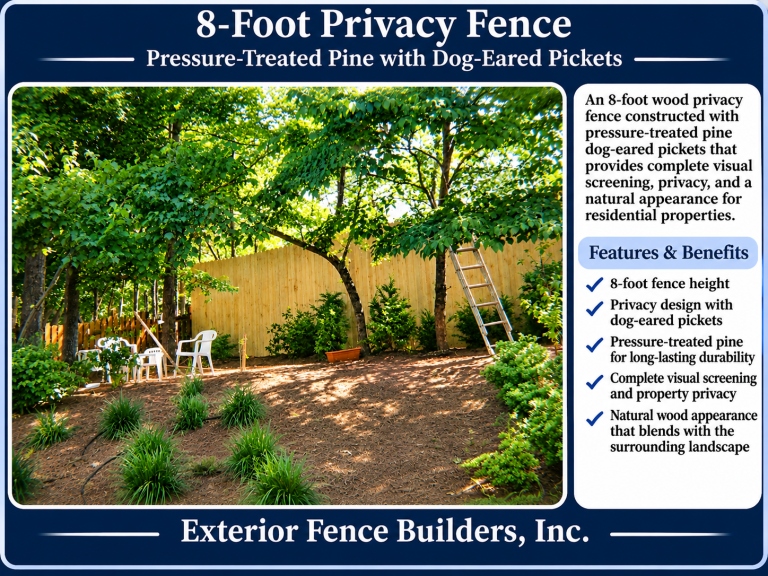
Each project presentation includes an original photograph alongside an updated visual presentation describing the fence style, materials, construction features, and intended application.
Original photographs preserve the historical record of our work. Updated presentations provide additional information to help homeowners, business owners, property managers, contractors, and other property decision-makers recognize the differences between fence styles and construction options.
These projects demonstrate the variety of fencing applications we’ve completed, including residential privacy fencing, decorative wood fences, community entrance features, perimeter enclosures, and specialized property improvements.
Digitally reconstructed presentations are identified separately from original photographs and should not be interpreted as untouched photographic records.
Wood Fence Installation in Lawrenceville, Gwinnett County and Metro Atlanta
Exterior Fence Builders, Inc. is a family-owned residential and commercial fence installation and repair company established in 1988 and based in Lawrenceville, Georgia.
Our established service territory includes Gwinnett County and surrounding Northeast Georgia and Metro Atlanta communities, including Lawrenceville, Snellville, Lilburn, Duluth, Norcross, Suwanee, Buford, Dacula, Grayson, Loganville, Winder, Monroe, Conyers, and Decatur.
We provide wood fence installation, replacement, and repair services for a range of property owners and organizations, including:
Homeowners and residential property owners seeking privacy fencing, decorative fencing, property boundaries, and outdoor improvements.
Business owners and commercial property owners requiring wood fencing for property separation, perimeter definition, privacy screening, and property improvements.
Commercial property managers and landlords coordinating fence installations, replacements, and repairs for properties under their management.
Homeowners associations and community associations responsible for subdivision entrances, common areas, perimeter fencing, and community property maintenance.
Real estate investors and property management companies maintaining, improving, or preparing residential and commercial properties.
Developers, builders, and general contractors seeking professional fence installation services for residential developments, commercial projects, and property improvements.
Schools, institutional facilities, and other property representatives evaluating appropriate wood fencing solutions for grounds, boundaries, and designated outdoor areas.
Our objective is to provide professional fencing services that meet the property’s requirements, complement its surroundings, and reflect the construction standards established by Exterior Fence Builders, Inc.
Growing Our Georgia Presence
Exterior Fence Builders is also developing its Southeast Georgia market, with a focus on Bryan County, Richmond Hill, Ellabell, Pembroke, Pooler, and surrounding communities.
This developing region is part of our future service expansion and is separate from our established Northeast Georgia operations.
Our long-term business-development vision extends across the Southeastern Corridor: Georgia, Alabama, Mississippi, Louisiana, Florida, North Carolina, South Carolina, and Tennessee. These states represent future opportunities, not a claim that regular fence installation services are currently available throughout all eight states.
Find the Wood Fence That’s Right for Your Property
Whether you’re considering a traditional 6-foot wood privacy fence, a cedar fence, a shadowbox design, a decorative picket fence, a custom wood fence, or fencing for a commercial property or community development, our completed projects can help you understand your options.
Browse the different styles, examine the construction details, and discover how professional wood fencing can serve your property’s needs.
From individual homeowners to commercial property owners, property managers, homeowners associations, and contractors, Exterior Fence Builders, Inc. welcomes the opportunity to discuss fencing projects that match our services and experience.
Ready to discuss your residential or commercial fencing project?
Exterior Fence Builders, Inc. — Family-Owned Since 1988.
FAQ About Wood Fences
Western Red Cedar
Where does Western Red Cedar come from?
It's unique to the West Coast of North America. In British Columbia it makes up almost 21% of the coastal forests. In the rest of the growing range, it comprises three to twelve percent of the total growth, along with Douglas Fir and Western Hemlock. Inland Red Cedar is a sub-species of Western Red Cedar that grows in an area that follows the Rocky Mountains, goes south from mid-British Columbia to the Salmon River and extends westward from Helena, Montana to Spokane, Washington.
What's the difference between nominal and actual thickness?
Nominal is a size designation most lumber uses for convenience. In lumber, the nominal size is usually greater than the actual size.
Thickness:
| Nominal | Actual |
|---|---|
| 1" | 3/4" |
| 1" | 21/32" |
| 1" | 5/8" |
Producers have determined that the thinner sizes still have acceptable performance. Also, due to rising cost, raw-material producers receive a better return with thinner products.
How does full width differ from scant width?
All lumber is produced with a stated width, which is the target size. As milling has become more accurate, target sizes have moved closer to surfaced or planed sizes, i.e. 5 1/2". As the width diminishes, the actual width is scant-or less than-the nominal width. See examples below:
| Full Width | Scant Width |
|---|---|
| 6" | 5-1/2" |
| 4" | 3-1/2" |
| 3" | 2-1/2" |
Why do knots fall out of boards, creating holes?
Knots and the surrounding wood have different densities. Since knots are more dense, they expand and contract less than the surrounding wood, loosening the bond. To protect against this, use a Premium or #1 board with both faces graded. The knots will be smaller and intergrown. The cost is slightly more, but your fence will have a longer serviceable life.
What causes Cedar boards to develop black stains at the nails?
The stain is caused by natural wood extracts interacting with metal in the fastener. Moist wood increases the likelihood of this interaction. For Cedar, Redwood and Cypress, you should use double-dipped galvanized, stainless steel or aluminum fasteners.
Can the stained Cedar be cleaned off?
Yes. If the stain is has a brown tint to it, use a solution with Trisodium Phosphate (TSP), which is available at local retail hardware stores.
If the stain is black, use a solution with Oxalic Acid to clean the boards. This material is also available at retail hardware stores.
Commercial cleaners are available as well. Identify the cause of the stain to ensure you choose the correct product. Certain concrete cleaners are specifically formulated to clean wood extracts from patios, sidewalks, or other concrete structures.
What about using bleach and water?
Chlorine-based or Oxygen-type bleach is effective against mildew and fungi. Oxygen-type bleach contains sodium percarbonate, which when added to water forms hydrogen peroxide, an effective agent in removing mildew stains, dirt and weathered gray residue from wood that has ultraviolet (sunlight) degradation. Unlike chlorine-based bleach, once the wood is treated with the oxygen-type bleach, it will return to its original natural appearance.
Some species of wood contain tannins, a natural resin. Water can extract these resins from wood leaving brown or black discolorations on the surface. Blue-black stains can result from a reaction of tannins to the iron in nails or fasteners. Neither chlorine nor oxygen bleaches are effective against tannin or iron stains, but the use of an oxalic acid-based product mentioned previously will render the stains colorless.
Why do boards split when fastened with nails?
Correct nails and nailing practices are essential for successful installation. Choosing a needle point nail is a common mistake. While the most commonly used nail is a diamond point, a blunt point will reduce splitting also. Overdriving nails is another problem that distorts wood and causes excessive splitting. Predrilling will help reduce any splitting that can occur.
The boards at the top of my fence are warping. Why?
The backrails should be no more than 8" from the fence board tops and bottoms. Fence boards 6' long should have three back rails. Spacing your rails this way will help control the wood's natural tendency to warp, due to expansion and contraction.
What can be done to eliminate the effects of weathering and keep that "new fence" look?
While there's no way to eliminate the weathering of wood, it's relatively easy to minimize the effects:
- Use three back rails (6' fence), two backrails (4', 5' fence), or 4 backrails (8' fence) for more hold-down points.
- Use only hot-dipped galvanized, or stainless steel fasteners with a ring or spiral shank to minimize warp and rust stains.
- Treat the surfaces of fence boards with a water-repellant solution to reduce the rate that moisture is absorbed and released. This solution should also have a good UV inhibitor if you don't want the fence to gray.
- Follow a regular maintenance program of cleaning and refinishing every few years with a "clear" or "toner" water repellant containing UV inhibitors. This will revitalize a dingy appearance caused by dirt, mildew or graying. It's like washing and waxing your car. Opinions differ on how necessary it is to perform regular maintenance, but most agree your fence will look much better for the effort.
Redwood
- Where does Redwood come from?
- What's the difference between nominal and actual thickness?
- How does full width differ from scant width?
- Why do knots fall out of boards, creating holes?
- What causes Redwood boards to develop black stains at the nails?
- Can the stained Redwood be cleaned off?
- What about using bleach and water?
- Why do boards split when fastened with nails?
- The boards at the top of my fence are warping. Why?
- What can be done to eliminate the effects of weathering and keep that "new fence" look?
Northern White Cedar
- Where does Northern White Cedar come from?
- What's the difference between nominal and actual thickness?
- How does full width differ from scant width?
- Why do knots fall out of boards, creating holes?
- What causes Cedar boards to develop black stains at the nails?
- Can the stained Cedar be cleaned off?
- What about using bleach and water?
- Why do boards split when fastened with nails?
- The boards at the top of my fence are warping. Why?
- What can be done to eliminate the effects of weathering and keep that "new fence" look?
Treated Wood
- What's pressure-treated wood?
- What are some of the advantages of pressure-treated wood?
- What kind of treated wood is available?
- What guarantee does treated wood have?
- What about any cracking, warping, and graying that may show up over time?
- What can be done to eliminate the effects of weathering and keep that "new fence" look?
Whitewood
- What are Whitewoods and where do they grow?
- What are the black spots on my boards?
- Can the mold or mildew be cleaned off my boards?
- How long can I expect my Whitewood fence boards to last?
- Why do knots fall out of boards, creating holes?
- What can be done to eliminate the effects of weathering and keep that "new fence" look?
Original Photographs. Updated Presentations. Documented Experience.
Our Wood Fence Styles, Designs & Photos gallery is built around actual residential, commercial, and specialty fencing projects completed by Exterior Fence Builders, Inc.
Unlike a collection of generic fence illustrations, our gallery preserves the original photographs of our completed installations and pairs them with updated presentations that explain what makes each fence distinctive.
Original Project Photographs — Our Historical Record
The original photograph appears on the left side of each project display.
These photographs document actual fencing work completed by Exterior Fence Builders, Inc., including the fence’s appearance, surrounding property, and visible construction details at the time the photograph was taken.
Some photographs date back many years and reflect the photographic equipment and image quality available at the time.
We preserve these photographs as part of our company’s construction history and record of completed projects.